A water molecule is one oxygen atom with two hydrogen atoms attached. Each O-H connection is a covalent bond, which means the two atoms share a pair of electrons.
The sharing is not fair. Oxygen is more electronegative, which is a word for "pulls shared electrons harder." So the electrons spend more time near oxygen.
- The oxygen end becomes slightly negative. We write this as δ− (say "partial negative").
- Each hydrogen end becomes slightly positive, written δ+.
- The molecule is bent, not straight, so the negative end and the positive ends sit on different sides. They do not cancel.
A molecule with uneven charge like this is called polar. Here is the key point students miss: a polar molecule is still neutral overall. The partial charges add up to zero. An ion, like Na+ or Cl−, is different: it has a full net charge because it gained or lost electrons.
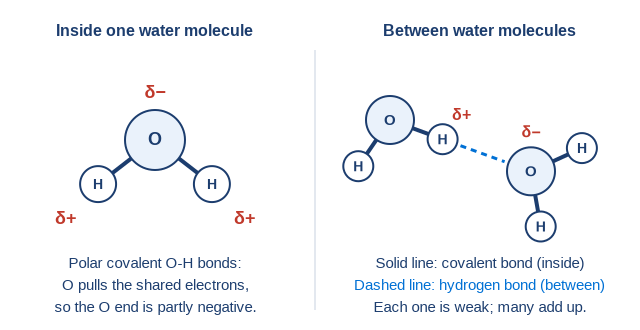
A hydrogen bond is an attraction between a hydrogen that is bonded to an electronegative atom (like the H in O-H) and another electronegative atom nearby. In liquid water, the δ+ hydrogen of one molecule is attracted to the δ− oxygen of a neighbor. These bonds form and break constantly.
| Covalent O-H bond | Hydrogen bond |
|---|
| Where it is | Inside one water molecule | Between two molecules |
| What it is | Shared electrons | Attraction of partial charges |
| Strength | Strong | Weak one at a time; many add up |
| Broken when water boils or evaporates? | No | Yes, the molecule leaves its neighbors |
Trap: "When water evaporates, the O-H bonds break." No. Evaporating water is still H2O. Melting and evaporation change how far apart the molecules are and how they are arranged. They do not split water into hydrogen and oxygen. That would be a chemical reaction.
Quick check 1. A potassium ion, K+, is dissolved in water. (a) Which atom of each nearby water molecule tends to point toward it? (b) Does a water molecule next to the ion have a net charge?