Class prep · TJ AP Calculus BC

Learn BC calculus from zero,then practice at test level.

Short lessons that start from zero and build one idea at a time, then original problems at the depth of a hard unit test. Each problem has a full worked solution. Built by Neil Kothari, a TJ alumnus.

$395 covers the full school year. The first module is free.

Try one. This is a test-level problem from the course.

Problem 1

  • Test level
  • Multiple choice
  • No calculator
  • 4 pts

Functions ff and gg satisfy lim⁡x→1−f(x)=3\displaystyle\lim_{x\to1^-}f(x)=3, lim⁡x→1+f(x)=−1\displaystyle\lim_{x\to1^+}f(x)=-1, f(1)=2f(1)=2, lim⁡x→1−g(x)=−1\displaystyle\lim_{x\to1^-}g(x)=-1, lim⁡x→1+g(x)=3\displaystyle\lim_{x\to1^+}g(x)=3, and g(1)g(1) is undefined. Which of the following limits exist? I. lim⁡x→1[f(x)+g(x)]II. lim⁡x→1[f(x) g(x)]III. lim⁡x→1f(x)g(x)\text{I. }\lim_{x\to1}\big[f(x)+g(x)\big]\qquad \text{II. }\lim_{x\to1}\big[f(x)\,g(x)\big]\qquad \text{III. }\lim_{x\to1}\frac{f(x)}{g(x)}

Choose one answer

original problems, each with a full worked solution
780
original problems, each with a full worked solution
at test level or beyond
540
at test level or beyond
short lessons, one for every idea
60
short lessons, one for every idea
units, the whole course
10
units, the whole course

Free lesson

Lesson 1.1: What a Limit Means and How to Read One

How a limit turns average speed into speed at an instant, how to read one-sided and two-sided limits from graphs, piecewise rules and the floor function, and how limits of sums, products and compositions behave. Covers College Board AP Calculus BC topics 1.1 to 1.3.

This lesson starts from a simple question and builds up one idea at a time.

Start with a question

A running app on your phone can tell you your average pace for the last mile. A car's speedometer does something stranger. It shows your speed right now, at a single instant.

Speed is distance divided by time. At a single instant, no time passes and no distance is covered. So the speedometer seems to be computing 00\frac{0}{0}, which means nothing. Yet the number on the dial is real, and you can get a ticket for it.

Calculus settles this with one idea: the limit. A limit asks where a quantity is heading, not where it is. This lesson is about what that means and how to read limits off graphs and formulas.

By the end of this lesson you will be able to:

  1. Explain in plain words what lim⁡x→cf(x)=L\lim_{x\to c}f(x)=L says, and why the value f(c)f(c) plays no part in it.
  2. Turn average rates of change into an instantaneous rate using forward, backward and symmetric difference quotients.
  3. Read one-sided and two-sided limits from a graph, a piecewise formula, or a floor function.
  4. Find limits of sums, products, quotients and compositions, even when the pieces jump.

From average speed to speed at an instant

A sled slides down a hill. After tt seconds it is s(t)=2t2+ts(t)=2t^2+t meters from the top. How fast is it going at exactly t=1.5t=1.5 seconds?

You already know how to find an average speed: change in distance divided by change in time. At t=1.5t=1.5 the sled is s(1.5)=2(2.25)+1.5=6s(1.5)=2(2.25)+1.5=6 meters down. At t=2.5t=2.5 it is s(2.5)=12.5+2.5=15s(2.5)=12.5+2.5=15 meters down. So over the interval [1.5, 2.5][1.5,\,2.5] its average speed is

15−62.5−1.5=9 m/s.\frac{15-6}{2.5-1.5}=9\text{ m/s}.

That is too crude, because the sled speeds up during that second. Shrink the interval and watch the averages.

IntervalAverage speed (m/s)
[1.5, 2.5][1.5,\,2.5]99
[1.5, 1.6][1.5,\,1.6]7.27.2
[1.5, 1.51][1.5,\,1.51]7.027.02
[1.5, 1.501][1.5,\,1.501]7.0027.002

The averages are closing in on 77. Algebra confirms it. Let hh stand for the length of the time interval, so the interval is [1.5, 1.5+h][1.5,\,1.5+h]. The average speed over it is

s(1.5+h)−s(1.5)h=2(1.5+h)2+(1.5+h)−6h=7h+2h2h=7+2h,h≠0.\frac{s(1.5+h)-s(1.5)}{h}=\frac{2(1.5+h)^2+(1.5+h)-6}{h}=\frac{7h+2h^2}{h}=7+2h,\quad h\neq0.

As hh shrinks toward 00, the quantity 7+2h7+2h heads to 77. So the sled's speed at t=1.5t=1.5 is 77 m/s.

Here is the catch. At h=0h=0 the original fraction is 00\frac{0}{0}. You cannot find speed at an instant by plugging in. You can only ask where the averages are heading. That question is a limit, and it is the reason calculus starts here. We write

lim⁡h→0s(1.5+h)−s(1.5)h=7.\lim_{h\to0}\frac{s(1.5+h)-s(1.5)}{h}=7.

Read it aloud as "the limit, as hh approaches 00, of the average speed is 77."

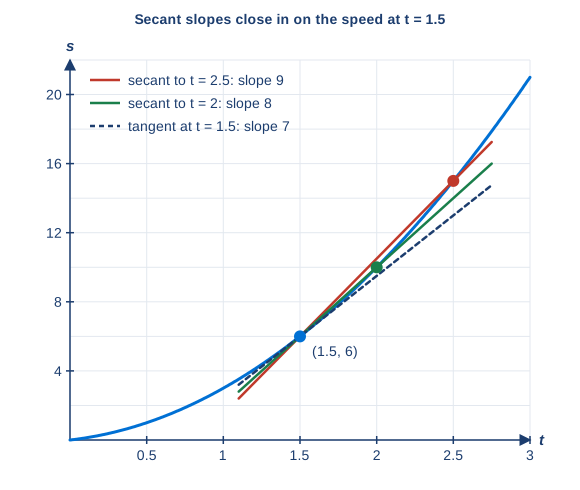
The graph of s equals 2t squared plus t with secant lines of slope 9 and 8 from the point at t equals 1.5, closing in on the tangent line of slope 7

On the graph, each average speed is the slope of a secant line, a line through two points of the curve. As the second point slides toward the first, the secant lines settle onto the tangent line, the line that just touches the curve at that point. Its slope, 77, is the instantaneous speed.

Three ways to average

You can build the interval on either side of the instant, or around it.

QuotientFormulaUses the interval
Forwards(a+h)−s(a)h\dfrac{s(a+h)-s(a)}{h}[a, a+h][a,\,a+h], just after aa
Backwards(a)−s(a−h)h\dfrac{s(a)-s(a-h)}{h}[a−h, a][a-h,\,a], just before aa
Symmetrics(a+h)−s(a−h)2h\dfrac{s(a+h)-s(a-h)}{2h}[a−h, a+h][a-h,\,a+h], centered on aa

All three head to the same instantaneous rate as h→0h\to0 for a smooth motion like this sled. For a fixed hh, the symmetric quotient is usually the best estimate, and it is exactly the average of the forward and backward quotients.

Method: instantaneous rate at t=at=a

  1. Write the forward quotient s(a+h)−s(a)h\frac{s(a+h)-s(a)}{h} with the actual formula for ss.
  2. Expand and simplify the top until a factor of hh appears in every term.
  3. Cancel hh, which is allowed because h≠0h\neq0.
  4. Let h→0h\to0 in what is left.

For the sled at a general time aa: s(a+h)−s(a)=2(2ah+h2)+h=4ah+2h2+hs(a+h)-s(a)=2(2ah+h^2)+h=4ah+2h^2+h. Dividing by hh gives 4a+2h+14a+2h+1, which heads to 4a+14a+1. At a=1.5a=1.5 that is 77, as before.

Worked example 1: a bead on a wire

A bead's position is s(t)=8−12t+2s(t)=8-\frac{12}{t+2} centimeters after tt seconds. Find its speed at t=2t=2, and compare the three quotients when h=1h=1.

Step 1: the value at t=2t=2. s(2)=8−124=5s(2)=8-\frac{12}{4}=5.

Step 2: forward quotient. s(2+h)=8−124+hs(2+h)=8-\frac{12}{4+h}, so

s(2+h)−s(2)=3−124+h=3(4+h)−124+h=3h4+h.s(2+h)-s(2)=3-\frac{12}{4+h}=\frac{3(4+h)-12}{4+h}=\frac{3h}{4+h}.

Dividing by hh (allowed, h≠0h\neq0) gives 34+h\frac{3}{4+h}.

Step 3: let h→0h\to0. 34+h→34\frac{3}{4+h}\to\frac34. The speed at t=2t=2 is 34\frac34 cm/s.

Step 4: the backward quotient. The same algebra with 2−h2-h gives s(2)−s(2−h)=3h4−hs(2)-s(2-h)=\frac{3h}{4-h}, so the backward quotient is 34−h\frac{3}{4-h}. It also heads to 34\frac34.

Step 5: compare at h=1h=1. Forward: 35=0.6\frac35=0.6. Backward: 33=1\frac33=1. Symmetric: s(3)=8−2.4=5.6s(3)=8-2.4=5.6 and s(1)=8−4=4s(1)=8-4=4, so 5.6−42=0.8\frac{5.6-4}{2}=0.8.

Check: the symmetric value 0.80.8 is the average of 0.60.6 and 11, as the table promised, and it is the closest of the three to 0.750.75.

Quick check 1. For s(t)=t2+3ts(t)=t^2+3t, simplify the forward quotient on [2, 2+h][2,\,2+h] and find the speed at t=2t=2.

Problem 2

  • Core
  • True or false
  • No calculator
  • 2 pts

True or False: A function gg can satisfy both lim⁡x→3g(x)=−1\displaystyle\lim_{x\to 3}g(x)=-1 and g(3)=8g(3)=8. Justify your answer.

Is the statement true or false?

Problem 3

  • Core
  • Multiple choice
  • No calculator
  • 4 pts

Which statement means exactly the same thing as lim⁡x→−3+r(x)=6\displaystyle\lim_{x\to-3^{+}}r(x)=6?

Choose one answer

Open the rest of this lesson, free

The full lesson and all 13 of its problems, with every solution.

I am aI am a

Your free lesson opens right here, on this device for 30 days. We'll email you occasional TJ class prep updates. Unsubscribe anytime.

How it works

Class prep that works alongside class

For students currently taking AP Calculus BC. It works alongside class, not in place of it. Students who already know the material can go straight to the test-level problems. Students who feel behind rebuild a topic with the lesson before they try the problems.

  • Every problem is original, from quick checks to long multi-part problems.
  • True or false, multiple choice, multi-part and free response, each marked core, test level or beyond, and calculator or no calculator.
  • Solutions show every step and end with the mistake that most often costs points.
  • Diagrams wherever a picture makes the idea clear.

What is inside

  1. 1Limits and Continuity6 lessons · 78 problems
  2. 2Differentiation: Definition and Fundamental Properties6 lessons · 78 problems
  3. 3Differentiation: Composite, Implicit, and Inverse Functions6 lessons · 78 problems
  4. 4Contextual Applications of Differentiation6 lessons · 78 problems
  5. 5Analytical Applications of Differentiation6 lessons · 78 problems
  6. 6Integration and Accumulation of Change6 lessons · 78 problems
  7. 7Differential Equations6 lessons · 78 problems
  8. 8Applications of Integration6 lessons · 78 problems
  9. 9Parametric Equations, Polar Coordinates and Vector-Valued Functions6 lessons · 78 problems
  10. 10Infinite Sequences and Series6 lessons · 78 problems
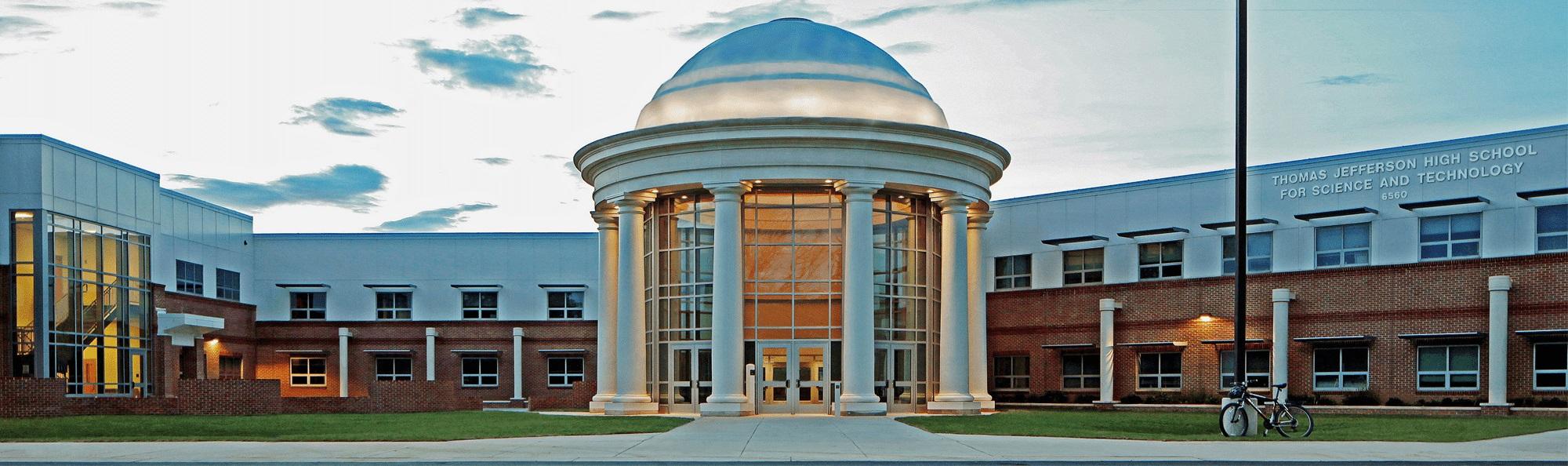
The front entrance of Thomas Jefferson High School for Science and Technology
Neil Kothari, co-founder of EduAvenues

Who built it

Neil Kothari

TJHSST alumnus · Co-founder, EduAvenues · 10+ years in TJ preparation

Neil went to TJ himself and has spent more than a decade working with TJ students and their families. He built this course so students can learn each idea from the beginning and then test themselves on it. Every problem is original and every answer is checked before it goes in.

Tuition

$395for the full school year

One tuition covers every unit of the course. All 10 units are open now. The What a Limit Means and How to Read One lesson stays free for everyone.

  • 10 units open now: 60 lessons and 780 original problems
  • A full worked solution for every problem
  • Access through the end of the school year
Enroll