Class prep · TJ AP Precalculus

TJ math tests are harder than class.Practice at test level.

Short lessons on every idea, then original problems written like a TJ unit test, each with a full worked solution. Built by Neil Kothari, a TJ alumnus.

$395 covers the full school year. The first module is free.

Try one. This is the level a TJ unit test asks for.

Problem 1

  • Test level
  • Multiple choice
  • No calculator
  • 4 pts

Let f(x)=kx+2x+1f(x) = \dfrac{kx + 2}{x + 1}, where kk is a constant. The average rate of change of ff on [−12,3]\left[-\tfrac12, 3\right] is −12-\tfrac12. What is the value of kk?

Choose one answer

original problems, each with a full worked solution
355
original problems, each with a full worked solution
written at TJ unit test level or past it
247
written at TJ unit test level or past it
short lessons, one for every idea
26
short lessons, one for every idea
units, all available now
4
units, all available now

Free lesson

Lesson 1.2: Rates of Change

How to measure how fast a function changes, tell which way its graph bends, and build a model from a table, using only algebra.

Start with a question

You leave home at 1 p.m. At 4 p.m. you are 150 miles away. How fast did you drive?

Most people say "50 miles per hour", and that is a good answer. But you did not drive 50 the whole time. You sat at a red light, you sped up on the highway, and you stopped for gas. The number 50 is an average. It only uses two readings, where you were at the start and where you were at the end.

Now suppose you drive 75 miles out, turn around, and come back home by 4 p.m. Your change in position is 0, so your "average" is 0 miles per hour. You clearly were not parked all afternoon.

That is the whole lesson in a nutshell. An average rate of change is a powerful number, but it only knows about the two endpoints. To understand a function you also need to know how the rate itself is changing.

By the end of this lesson you will be able to:

  • find the average rate of change of a function from a formula, a table or a graph, exactly and with units,
  • explain what an average rate does and does not tell you, including across an asymptote,
  • decide whether a function is concave up or concave down from its rates, and find a cubic's inflection point,
  • use first, second and third differences to recognize and build linear, quadratic and cubic models,
  • solve for unknown coefficients from facts about rates.

Three questions about change

When the input of a function moves, the output moves too. Every problem in this lesson asks one of three questions about that movement.

  1. Which way? Is the function going up or down? That is the sign of the rate of change.
  2. How steeply? That is the size of the rate of change.
  3. Is the steepness changing? Is the rate itself going up or down? That is concavity.

Keep these three apart. Most lost points in this unit come from mixing them up, for example saying "concave down" when you mean "going down".

Problem 2

  • Core
  • True or false
  • No calculator
  • 2 pts

True or False: For f(x)=x2−6xf(x) = x^2 - 6x, the average rate of change of ff on [1,5][1, 5] is 00, so ff is constant on [1,5][1, 5]. Justify your answer.

Is the statement true or false?

Problem 3

  • Core
  • Multiple choice
  • No calculator
  • 4 pts

Let f(x)=2x+1x−3f(x) = \dfrac{2x + 1}{x - 3}. What is the average rate of change of ff on the interval [4,7][4, 7]?

Choose one answer

Open the rest of this lesson, free

The full lesson and all 13 of its problems, with every solution.

I am aI am a

Your free lesson opens right here, on this device for 30 days. We'll email you occasional TJ class prep updates. Unsubscribe anytime.

How it works

Built for the gap between class and the test

It works alongside class, not in place of it. Students who already know the material get faster and more careful under test conditions. Students who feel behind rebuild a topic with the lesson before they try the problems.

  • Every problem is original, in the TJ test formats: true or false with a written justification, multiple choice, and multi-part free response.
  • Each one is marked core, test level or beyond the test, and calculator or no calculator.
  • Solutions show every step and end with the mistake that most often costs points.
  • Short whiteboard explainer videos are being added, starting with the hardest ideas.

What is inside

  1. 1Polynomial and Rational Functions6 lessons · 81 problems
  2. 2Exponential and Logarithmic Functions6 lessons · 81 problems
  3. 3Trigonometric and Polar Functions7 lessons · 103 problems
  4. 4Functions Involving Parameters, Vectors, and Matrices7 lessons · 90 problems
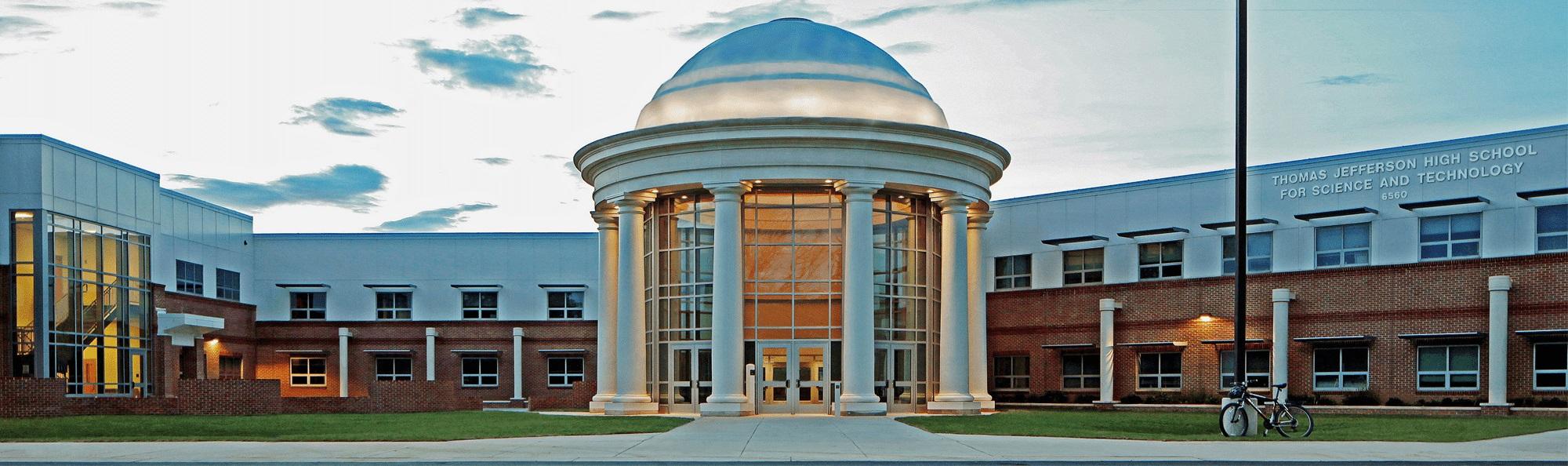
The front entrance of Thomas Jefferson High School for Science and Technology
Neil Kothari, co-founder of EduAvenues

Who built it

Neil Kothari

TJHSST alumnus · Co-founder, EduAvenues · 10+ years in TJ preparation

Neil sat in these classrooms himself and has spent more than a decade working with TJ students and their families. He built this course for the problem families describe most: a student who keeps up in class and still loses points on the unit test. Every problem is written for the course and every answer is checked before it goes in.

Tuition

$395for the full school year

One tuition covers every unit of the course. All 4 units are available now. The Rates of Change lesson stays free for everyone.

  • All 4 units: 26 lessons and 355 original problems
  • A full worked solution for every problem
  • New explainer videos as they are added
  • Access through the end of the school year
Enroll