Class prep · TJ AP Research

Ask one question,then defend the answer.

An independent AP Research course, from a question and the literature through a method, evidence, the paper, and the presentation. Every practice exercise has a model answer and a rubric. Built by Neil Kothari, a TJ alumnus.

$395 covers the full school year. The first lesson is free.

Try one. This is a checkpoint exercise from the course.

Problem 1

  • Core
  • Multiple choice
  • No calculator
  • 4 pts

Priya is writing the student deadline into her calendar for the bus-stop paper. Which entry matches the 2026-27 date published on AP Central?

Choose one answer

practice exercises, each with a model answer
288
practice exercises, each with a model answer
at test level or beyond
144
at test level or beyond
short lessons, one for every topic
48
short lessons, one for every topic
units, all open now
8
units, all open now

Free lesson

Lesson 1.1: What the Course Scores

AP Research is scored on a paper and a live presentation, each with its own scorer, weight and scale, and this lesson shows you how to keep them apart.

Start with what the course scores, and what you submit.

Start with a question

Imagine a cooking contest with two rounds. In round one, judges taste a dish you cooked at home and give it one grade from 1 to 5. In round two, you cook live in front of a panel, and your teacher scores you out of 24 points.

Your friend says, "Just add the 4 and the 20 and divide by 2."

Something feels off. A 4 out of 5 and a 20 out of 24 are not on the same scale. And the contest rules already say how much each round counts. Your friend is making up a formula the organizers never gave.

AP Research works the same way. There is no sit-down written exam. Your score comes from two products, and each one has its own scorer, its own weight and its own scale. Most mistakes in the first weeks come from mixing those up.

By the end of this lesson you will be able to:

  • name the two scored products and say who scores each one,
  • give each product's weight (75 percent and 25 percent) and its scale (1 to 5, and up to 24 points),
  • explain why you must never average or add the two raw scores yourself,
  • tell the student deadline apart from the teacher deadline,
  • say what the PREP, AP Seminar, a TJ research lab and this prep course are, and why none of them is a third score.

The two products

A product here just means a finished piece of work that gets scored. AP Research has exactly two.

  1. The academic paper. This is a written research paper, in the style of one academic field (a "discipline-style" paper), of 4,000 to 5,000 words. You submit it as final in the digital portfolio, the online place where College Board collects your work.
  2. The presentation and oral defense, often shortened to POD. This is one live event where you present your research and then answer questions from a panel.

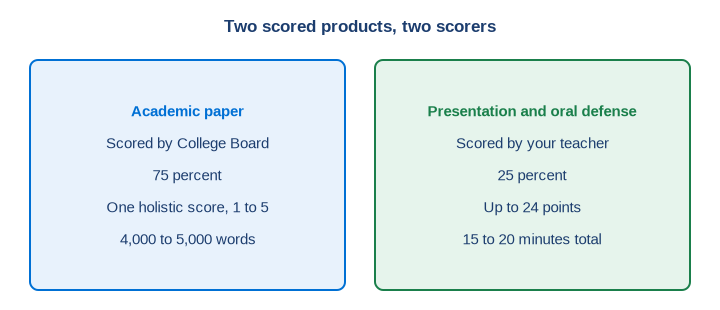
Here is the whole picture in one table. Read it row by row.

Academic paperPresentation and oral defense (POD)
Who scores itCollege BoardYour AP Research teacher
Weight in the AP Research score75 percent25 percent
ScaleOne holistic score from 1 to 5 (2026)Up to 24 points
What it isA 4,000 to 5,000 word discipline-style paperOne live event, 15 to 20 minutes total, questions included
Where it goesSubmitted as final in the digital portfolioGiven live; the teacher enters the score

Two boxes side by side: the academic paper, scored by College Board, 75 percent, one holistic score from 1 to 5; and the presentation and oral defense, scored by the teacher, 25 percent, up to 24 points

Two words in that table need plain definitions.

  • Weight means how much of the final AP Research score a product counts for. The paper counts for 75 percent, three quarters. The presentation counts for 25 percent, one quarter. Together they make 100 percent.
  • Holistic means the reader looks at the whole paper and gives it one score. In 2026 the paper gets a single mark from 1 to 5. It is not a stack of section points added together.

The presentation is different. Its score is out of 24 points, and it comes from a rubric with seven rows. Lesson 1C walks through those rows. For now, remember the total: 3 + 6 + 3 + 6 + 2 + 2 + 2 = 24.

Quick check 1. Who scores the academic paper, and what percent of the AP Research score is it? Answers are at the end of the lesson.

Problem 2

  • Core
  • True or false
  • No calculator
  • 2 pts

True or False: Priya can average her 1-to-5 paper score with her 24-point defense, then divide by 2, and that quotient is her AP Research score. Justify with the rule from the lesson.

Is the statement true or false?

Open the rest of this lesson, free

The full lesson and all 6 of its exercises, with every model answer.

I am aI am a

Your free lesson opens right here, on this device for 30 days. We'll email you occasional TJ class prep updates. Unsubscribe anytime.

How it works

Class prep that works alongside class

A complete AP Research course for students taking AP Research. Work alongside the class. Each lesson shows a worked example, then a practice exercise with a model answer and a rubric.

  • Practice exercises in several formats: true or false, multiple choice, multi-part and free response.
  • Each one is marked core, test level or beyond.
  • Questions, literature, methods, evidence, the academic paper, and the presentation.
  • A model answer and a rubric for every exercise.
  • Worked examples of a weak draft and a stronger revision.

What is inside

  1. 1The Two Scored Products6 lessons · 36 exercises
  2. 2Questions and Project Goals6 lessons · 36 exercises
  3. 3Context and the Literature6 lessons · 36 exercises
  4. 4A Method Aligned to the Question6 lessons · 36 exercises
  5. 5Evidence and a New Understanding6 lessons · 36 exercises
  6. 6The Academic Paper6 lessons · 36 exercises
  7. 7Presentation and Oral Defense6 lessons · 36 exercises
  8. 8Checkpoints and Submission6 lessons · 36 exercises
The front entrance of Thomas Jefferson High School for Science and Technology
Neil Kothari, co-founder of EduAvenues

Who built it

Neil Kothari

TJHSST alumnus · Co-founder, EduAvenues · 10+ years in TJ preparation

Neil is a TJ alumnus and has spent more than a decade working with TJ students and their families. He built this course so a student can carry one question through a method, evidence, and a paper, and explain what the result does and does not show.

Tuition

$395for the full school year

One tuition covers every unit of the course. All 8 units are open now. The What the Course Scores lesson stays free for everyone.

  • All 8 units: 48 lessons and 288 practice exercises
  • A model answer and a rubric for every exercise
  • Access through the end of the school year
Enroll