Class prep · TJ Honors Chemistry

Understand chemistry,from the first atom to electrochemistry.

A full honors chemistry course taught with worked examples and original practice, aligned in depth to the front half of AP Chemistry and pitched for TJ-level reasoning. Every problem has a full worked solution. Built by Neil Kothari, a TJ alumnus.

$395 covers the full school year. The first module is free.

Try one. This is a test-level problem from the course.

Problem 1

  • Test level
  • Multiple choice
  • No calculator
  • 4 pts

A rectangular tank measures 2.0 m2.0\,\mathrm{m} by 50 cm50\,\mathrm{cm} by 30 cm30\,\mathrm{cm} and is completely filled with a liquid of density 0.90 g/cm30.90\,\mathrm{g/cm^3}. Which value is closest to the mass of the liquid? No calculator is needed.

Choose one answer

original problems, each with a full worked solution
390
original problems, each with a full worked solution
at test level or beyond
270
at test level or beyond
short lessons, one for every idea
30
short lessons, one for every idea
units, all available now
5
units, all available now

Free lesson

Lesson 1.1: Measuring, Converting and Trusting Numbers

You will learn to read an instrument honestly, keep the right digits through a calculation, convert units without slips and decide how far a result can be trusted.

This lesson starts from zero. No chemistry background is needed.

Start with a question

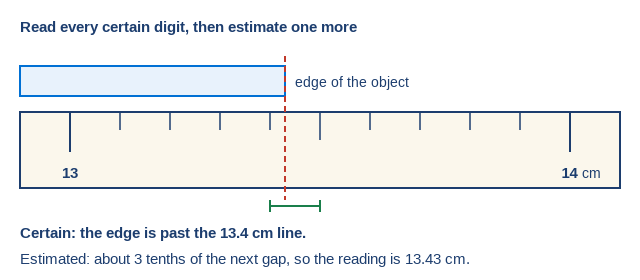
Hold a ruler marked in millimeters against a pencil.

The end lands between the 13.413.4 and 13.5 cm13.5\,\mathrm{cm} marks. It is a bit closer to 13.413.4.

What do you write down? 13.413.4? 13.513.5? 13.4313.43?

The best answer is 13.43 cm13.43\,\mathrm{cm}. You are sure of 13.413.4. You estimate the last 33 by eye. A friend might say 13.4213.42 or 13.4413.44. That shaky last digit is honest. It tells the reader how well the ruler can measure.

Every number in chemistry carries this message. A measurement is a number, a unit and an honest sense of its uncertainty. This lesson shows you how to protect that honesty through every calculation.

By the end of this lesson you will be able to:

  • count significant figures and round sums and products by the right rule
  • build conversion chains with prefixes, squared and cubed units, density and percents
  • separate accuracy from precision and random error from systematic error
  • carry uncertainty through a calculation and decide which measurement to improve
  • read density and container mass from a mass against volume graph

A ruler read to 13.43 cm: the 13.4 is certain and the final 3 is estimated

Significant figures: the digits that carry information

Significant figures are all the certain digits plus the one estimated digit. Three rules cover nearly every case.

  1. Nonzero digits always count. Zeros between nonzero digits count too.
  2. Leading zeros never count. They only place the decimal point.
  3. Trailing zeros count only if the number has a decimal point. Without one they are ambiguous. Write the number in scientific notation to remove the doubt.

So 12001200 could have two, three or four significant figures. Writing 1.20×1031.20\times10^{3} says three, and the doubt disappears.

Two kinds of numbers are exact and never limit your digits: things you count (1212 eggs) and defined conversions (1000 m=1 km1000\,\mathrm{m}=1\,\mathrm{km}).

Two rounding rules, not one

OperationWhat limits the answerExample
Multiply or divideThe fewest significant figures among the factors3.1×2.468=7.6508→7.73.1\times2.468=7.6508\to7.7
Add or subtractThe fewest decimal places among the terms7.218+15.3+0.0461=22.5641→22.67.218+15.3+0.0461=22.5641\to22.6

Addition cares about the place a number stops. Multiplication cares about how many digits it has. Keep one or two extra digits in your calculator and round once, at the end.

Worked example 1: counting, rounding and converting

How many significant figures are in 0.0702 g0.0702\,\mathrm{g}, 30.050 mL30.050\,\mathrm{mL}, 5.00×10⁻³ s5.00\times10^{-3}\,\mathrm{s} and 900 m900\,\mathrm{m}? Then write 3.50 kg3.50\,\mathrm{kg} in grams.

  1. 0.07020.0702: the leading zeros do not count; the 77, the middle 00 and the 22 do. Three.
  2. 30.05030.050: the middle zeros count, and the final zero counts because there is a decimal point. Five.
  3. 5.00×10−35.00\times10^{-3}: the coefficient holds the digits. Three.
  4. 900900: no decimal point, so it is ambiguous (one to three).
  5. 3.50 kg×1000 g1 kg=3.50×10³ g3.50\,\mathrm{kg}\times\dfrac{1000\,\mathrm{g}}{1\,\mathrm{kg}}=3.50\times10^{3}\,\mathrm{g}. Writing 3500 g3500\,\mathrm{g} would hide whether the zeros are measured.

Check: a power-of-ten conversion should never change the digit count. 3.503.50 and 3.50×1033.50\times10^{3} both show three.

Quick check 1. How many significant figures are in 0.03080 L0.03080\,\mathrm{L}? Then round 4.2×1.1354.2\times1.135 correctly. Answers are at the end of the lesson.

Problem 2

  • Core
  • True or false
  • No calculator
  • 2 pts

True or False: A balance reads to the nearest 0.01 g0.01\,\mathrm{g} and shows 12.40 g12.40\,\mathrm{g} for a rock. Writing the mass as 12400 mg12400\,\mathrm{mg} correctly shows that the measurement has four significant figures. Justify your answer.

Is the statement true or false?

Problem 3

  • Core
  • Multiple choice
  • No calculator
  • 4 pts

A student measures the density of a syrup and gets 1.30 g/mL1.30\,\mathrm{g/mL}. The accepted value is 1.25 g/mL1.25\,\mathrm{g/mL}. What is the percent error of the student's value?

Choose one answer

Open the rest of this lesson, free

The full lesson and all 13 of its problems, with every solution.

I am aI am a

Your free lesson opens right here, on this device for 30 days. We'll email you occasional TJ class prep updates. Unsubscribe anytime.

How it works

Class prep that works alongside class

A full honors chemistry course for grades 9 to 12. It works well alongside a school chemistry class and also stands on its own. Students who already know the material get faster and more careful. Students who feel behind rebuild a topic with the lesson before they try the problems.

  • Every problem is original and pitched for TJ-level reasoning: true or false, multiple choice, multi-part and free response.
  • Each one is marked core, test level or beyond, and calculator or no calculator.
  • Solutions show every step and end with the mistake that most often costs points.
  • Worked examples in every lesson, and diagrams wherever a picture makes the idea clear.

What is inside

  1. 1Matter, Measurement and the Atom6 lessons · 78 problems
  2. 2Bonding, Structure and Naming6 lessons · 78 problems
  3. 3The Mole, Reactions and Stoichiometry6 lessons · 78 problems
  4. 4Gases, Energy and Solutions6 lessons · 78 problems
  5. 5Rates, Equilibrium, Acids and Bases, Redox6 lessons · 78 problems
The front entrance of Thomas Jefferson High School for Science and Technology
Neil Kothari, co-founder of EduAvenues

Who built it

Neil Kothari

TJHSST alumnus · Co-founder, EduAvenues · 10+ years in TJ preparation

Neil is a TJ alumnus and has spent more than a decade working with TJ students and their families. He built this course so students can practice the particle-level reasoning and the calculations together. Every problem is written for the course and every answer is checked before it goes in.

Tuition

$395for the full school year

One tuition covers every unit of the course. All 5 units are available now. The Measuring, Converting and Trusting Numbers lesson stays free for everyone.

  • All 5 units: 30 lessons and 390 original problems
  • A full worked solution for every problem
  • Access through the end of the school year
Enroll