Class prep · TJ Advanced Mathematical Techniques

Match the technique,then check the model.

An independent course in mathematical techniques used in physics and chemistry. Special functions, generating functions, models, waves and complex amplitudes, each tied to a calculation you can finish by hand. Every problem has a full worked solution. Built by Neil Kothari, a TJ alumnus.

$395 covers the full school year. The first module is free.

Try one. This is a test-level question from the course.

Problem 1

  • Test level
  • Multiple choice
  • No calculator
  • 4 pts

Which number equals Γ(9)/Γ(8)\Gamma(9)/\Gamma(8)?

Choose one answer

original problems, each with a worked answer
624
original problems, each with a worked answer
at test level or beyond
432
at test level or beyond
short lessons, one for every topic
48
short lessons, one for every topic
units, all open now
8
units, all open now

Free lesson

Lesson 1.1: Gamma at Positive Integers

At a positive integer, Gamma is a factorial shifted down by one, so you can find its values, cancel its ratios, and work backward from a value to the input.

Start with the gamma function at the positive integers. Use the factorial identity, then say where the same function shows up in a model.

Start with a question

You have 5 songs and want to choose the order they play in. The first slot has 5 choices. Once that song is picked, the second slot has 4 choices, then 3, then 2, then 1. The number of possible playlists is

5⋅4⋅3⋅2⋅1=120.5 \cdot 4 \cdot 3 \cdot 2 \cdot 1 = 120.

That product has a name: 5 factorial, written 5!5!. In general, n!n! is the product of every whole number from 11 up to nn.

Factorials only make sense for whole numbers. You cannot line up 2.52.5 songs. But in physics and statistics, integrals keep producing "factorials" of numbers like 12\tfrac{1}{2} or 73\tfrac{7}{3}. Mathematicians built a function that agrees with factorials at whole numbers and fills in smoothly between them. It is called the Gamma function, written Γ\Gamma (the capital Greek letter gamma).

There is one catch, and it is the whole point of this lesson: Gamma is shifted by one. Γ(6)\Gamma(6) is not 6!6!. It is 5!=1205! = 120, the playlist count above.

By the end of this lesson you will be able to:

  • Evaluate Γ(n)\Gamma(n) at any positive integer nn as the factorial (n−1)!(n-1)!.
  • Simplify a ratio such as Γ(m)/Γ(k)\Gamma(m)/\Gamma(k) by cancelling, and check it a second way.
  • Work backward: given a value of Γ(n)\Gamma(n), find nn.
  • Read points on a graph of Gamma values and explain why those points do not lie on a line.
  • Explain why the shifted factorial rule holds for every positive integer.

The shifted factorial

Here is the rule in words: to find Gamma of a positive integer, step down by one, then take the factorial.

In symbols, for every positive integer nn:

Γ(n)=(n−1)!\Gamma(n) = (n-1)!

So Γ(n)\Gamma(n) multiplies all the positive integers strictly less than nn. The input nn itself is never one of the factors.

The empty product: why Γ(1)=1\Gamma(1) = 1

The rule gives Γ(1)=0!\Gamma(1) = 0!. What is 0!0!? It counts the ways to arrange zero songs. There is exactly one way: play nothing. A product with no factors at all is called the empty product, and it equals 11, the same way an empty sum equals 00.

There is a second reason. Factorials obey the step rule

(n+1)!=(n+1)⋅n!(n+1)! = (n+1) \cdot n!

Put n=0n = 0: you need 1!=1⋅0!1! = 1 \cdot 0!, and since 1!=11! = 1, that forces 0!=10! = 1. So Γ(1)=0!=1\Gamma(1) = 0! = 1. It is a real value, not undefined.

The table you should know by heart

nnΓ(n)\Gamma(n) as a factorialproductvalue
10!0!(empty product)1
21!1!111
32!2!1⋅21 \cdot 22
43!3!1⋅2⋅31 \cdot 2 \cdot 36
54!4!1⋅2⋅3⋅41 \cdot 2 \cdot 3 \cdot 424
65!5!1⋅2⋅3⋅4⋅51 \cdot 2 \cdot 3 \cdot 4 \cdot 5120

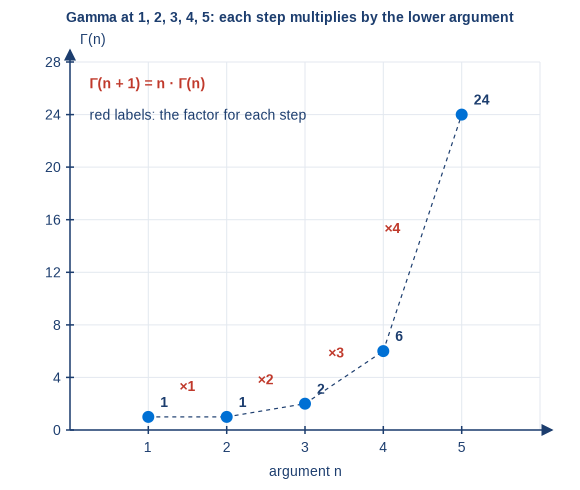
Two things to notice. First, Γ(1)=Γ(2)=1\Gamma(1) = \Gamma(2) = 1. That is the only place where two neighbors are equal. Second, each row is the row above it times one less than the new input. To go from Γ(4)=6\Gamma(4) = 6 to Γ(5)\Gamma(5), you multiply by 44, not by 55.

A staircase of points (1, 1), (2, 1), (3, 2), (4, 6), (5, 24). Each step up is labeled with its multiplier: times 1, times 2, times 3, times 4. The multiplier is always the input you are leaving.

The same fact, flipped around, is the factorial version of the step rule. Since Γ(n+1)=n!\Gamma(n+1) = n!, you can always write

Γ(n+1)=n⋅Γ(n).\Gamma(n+1) = n \cdot \Gamma(n).

Read it as: "to climb one step, multiply by the input you are leaving." The next lesson is built entirely on this one equation.

Quick check 1. Write Γ(6)\Gamma(6) as a factorial and as an integer. Answers are at the end of the lesson.

Where Gamma comes from: an integral

Gamma is not just a renamed factorial. For positive inputs it is defined by an integral:

Γ(n)=∫0∞t n−1e−t dt.\Gamma(n) = \int_0^{\infty} t^{\,n-1} e^{-t} \, dt.

You will not integrate this by hand on this page. What matters is the consequence. An integral of the form "power of tt times e−te^{-t}, from 00 to infinity" is called an exponential moment, and it always comes out to a factorial:

∫0∞t ne−t dt=n!=Γ(n+1).\int_0^{\infty} t^{\,n} e^{-t} \, dt = n! = \Gamma(n+1).

Notice the shift again. The power on tt is nn, the answer is n!n!, and in Gamma language that is Γ(n+1)\Gamma(n+1). For example, ∫0∞t5e−t dt=5!=Γ(6)=120\int_0^{\infty} t^{5} e^{-t}\,dt = 5! = \Gamma(6) = 120.

This is why Gamma shows up in TJ Advanced Mathematical Techniques. Integrals in physics (average energies of gas molecules, decay times) turn into exponential moments, and the volume of a ball in higher dimensions has a Gamma value in its formula. Lesson 1F covers those applications. Here you build the integer values by hand.

Gamma values are exact, pure numbers

Two habits to keep:

  1. Leave the answer as an integer. Γ(6)=120\Gamma(6) = 120 exactly. A decimal like 120.0120.0 is not more finished, and a rounded value loses information.
  2. No units. Γ(n)\Gamma(n) is a pure number (mathematicians say dimensionless). Writing "120 per second" invents a unit the function does not have. Units only appear later, when a physical model wraps a formula around the number.

Problem 2

  • Core
  • True or false
  • No calculator
  • 2 pts

True or false: Γ(7)=7!\Gamma(7)=7!. Justify with the integer definition.

Is the statement true or false?

Problem 3

  • Core
  • Multiple choice
  • No calculator
  • 4 pts

Which number equals Γ(8)\Gamma(8)?

Choose one answer

Open the rest of this lesson, free

The full lesson and all 13 of its problems, with every worked answer.

I am aI am a

Your free lesson opens right here, on this device for 30 days. We'll email you occasional TJ class prep updates. Unsubscribe anytime.

How it works

Class prep that works alongside class

A complete techniques course for students who know basic calculus and basic physics. Work alongside your school course or study the material in sequence. Each lesson starts with a formula you can evaluate, develops the identity, and shows the check before you try the practice.

  • Original problems in several formats: true or false, multiple choice, multi-part and free response.
  • Each one is marked core, test level or beyond.
  • Gamma and beta values, generating functions, equilibria, finite probability models, 2 by 2 modes, waves and phasors.
  • A worked answer for every problem, ending with the mistake that most often costs points.
  • Special functions, generating functions, rate models, small physical probability models, linear algebra in applications, waves and complex amplitudes.

What is inside

  1. 1Special functions6 lessons · 78 problems
  2. 2Generating functions6 lessons · 78 problems
  3. 3Modeling with differential equations6 lessons · 78 problems
  4. 4Probability in physical models6 lessons · 78 problems
  5. 5Linear algebra in applications6 lessons · 78 problems
  6. 6Waves6 lessons · 78 problems
  7. 7Complex numbers as a tool6 lessons · 78 problems
  8. 8Synthesis6 lessons · 78 problems
The front entrance of Thomas Jefferson High School for Science and Technology
Neil Kothari, co-founder of EduAvenues

Who built it

Neil Kothari

TJHSST alumnus · Co-founder, EduAvenues · 10+ years in TJ preparation

Neil is a TJ alumnus and has spent more than a decade working with TJ students and their families. He built this course so students can choose a technique, finish the calculation, and name the limit of the model. Every problem is written for the course and every answer is checked before it goes in.

Tuition

$395for the full school year

One tuition covers every unit of the course. All 8 units are open now. The Gamma at Positive Integers lesson stays free for everyone.

  • All 8 units: 48 lessons and 624 original problems
  • A worked answer for every problem
  • Access through the end of the school year
Enroll