Every formal charge uses three counts for one atom.
- Valence electrons (V): the electrons a free, neutral atom of that element has in its outer shell. Read it from the periodic table group.
- Nonbonding electrons (N): the electrons in lone pairs on that atom in the drawing. Count electrons, not pairs. One lone pair is 2 electrons.
- Bonding electrons (B): all the electrons in bonds that touch that atom. A single bond is 2, a double bond is 4 and a triple bond is 6. It does not matter that a double bond is one sigma bond plus one pi bond. For this count, every shared electron is just a shared electron.
| Atom | Group | Valence electrons V |
|---|
| H | 1 | 1 |
| B | 13 | 3 |
| C | 14 | 4 |
| N | 15 | 5 |
| O, S | 16 | 6 |
| F, Cl, Br, I | 17 | 7 |
The atom keeps all of its lone-pair electrons and half of its bonding electrons. That gives the formula, where F is the formal charge:
F=V−N−2B
Half the bonding electrons is the same as the number of bonds, because each bond holds 2 electrons. So you can also write the shortcut formal charge = valence electrons - lone-pair electrons - number of bonds. Use whichever version matches the information you are given. A problem that hands you "6 bonding electrons" wants you to halve it to 3. A drawing that shows three lines wants you to count 3 bonds.
- Find V from the group number.
- Count the lone-pair electrons on the atom to get N.
- Count the bonds to the atom (or halve the bonding electrons) to get 2B.
- Compute V−N−2B.
- Repeat for every atom that is not in its usual pattern, then add all the formal charges. The sum must equal the charge on the molecule or ion.
Step 5 is your error detector. A neutral molecule must have formal charges that add to 0. A cation with a charge of +1 must have formal charges that add to +1. If you draw a cation and every atom comes out 0, the structure is drawn wrong: an electron count is off somewhere.
The trap: do not subtract all the bonding electrons. Using 6−2−6 instead of 6−2−3 gives a large negative number that no real atom carries. If you ever get a formal charge of −3 on oxygen, you forgot to halve.
Hydronium, H3O+, has an oxygen bonded to three hydrogens with one lone pair. Find the formal charge on every atom.
- Oxygen is in group 16, so V=6. Reason: that is the electron count a neutral oxygen atom brings.
- Oxygen has one lone pair, so N=2. Reason: we count electrons, and a pair is two.
- Oxygen has three O-H bonds, so B=6 and 2B=3. Reason: each single bond holds 2 electrons, and oxygen keeps half.
- F=6−2−3=+1 for oxygen.
- Each hydrogen has V=1, no lone pairs and one bond: 1−0−1=0.
Check: the sum is (+1)+0+0+0=+1, which matches the charge on the ion. The positive charge belongs to oxygen, not to any hydrogen.
Problems sometimes give the three counts as a bar chart instead of a drawing. The chart below shows boron in the borohydride ion, BH4−.
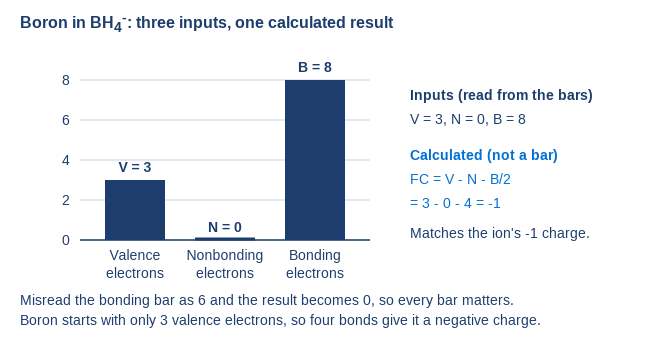
- Read each bar: V=3, N=0, B=8. Reason: the bars are the inputs, and each one is labeled with what it counts.
- Halve the bonding bar: 28=4. Reason: boron keeps half of each shared pair.
- F=3−0−4=−1.
- Each hydrogen has one bond and no lone pairs, so each is 0.
Check: the four bonds and no lone pairs give boron an octet, and the total −1+0+0+0+0=−1 matches the ion. Notice that the formal charge is not one of the bars. It is calculated from them. A chart question is only testing whether you read the three inputs correctly and then do the same subtraction as always.

