Class prep · TJ Quantum and Electrodynamics

Keep the field equations exact,then read the quantum state.

An independent course in quantum and electrodynamics. Work Maxwell's equations, relativity, and the Schrodinger equation, and say what each result means. Every problem has a full worked solution. Built by Neil Kothari, a TJ alumnus.

$395 covers the full school year. The first lesson is free.

Try one. This is a test-level question from the course.

Problem 1

  • Test level
  • Multiple choice
  • No calculator
  • 5 pts

A solid sphere of radius RR carries total charge QQ spread uniformly through its volume. What is the net electric flux through a concentric spherical Gaussian surface of radius R/2R/2?

Choose one answer

original problems, each with a worked answer
624
original problems, each with a worked answer
at test level or beyond
432
at test level or beyond
short lessons, one for every topic
48
short lessons, one for every topic
units, all open now
8
units, all open now

Free lesson

Lesson 1.1: Gauss's Law and Electric Flux

The net electric flux through any closed surface depends only on the charge inside it.

This lesson starts with what electric flux measures, counts the field lines through a closed surface, and uses symmetry to turn Gauss's law into a field.

Start with a question

A sealed cardboard box sits on a lab bench. You are not allowed to open it, but you have a probe that can measure the electric field at any point on the box's outer surface. Can you find out how much charge is hidden inside, without knowing where it sits or how it is arranged?

You can, and you do not even need the exact field pattern. You only need to add up how much field pokes out of the box minus how much pokes in. That total is called the electric flux, and Gauss's law says it equals the enclosed charge divided by one fixed constant. This lesson turns that idea into a set of reliable tools.

By the end of this lesson you will be able to:

  • compute the net flux through a closed surface from the charge it encloses, keeping signs;
  • work backward from a measured flux to the enclosed charge;
  • find the flux through a flat face in a uniform field, using the outward normal;
  • use symmetry to split a total flux among identical faces, and close an open surface to find its flux;
  • read a graph of flux against radius to locate charges, including thin shells.

What flux measures

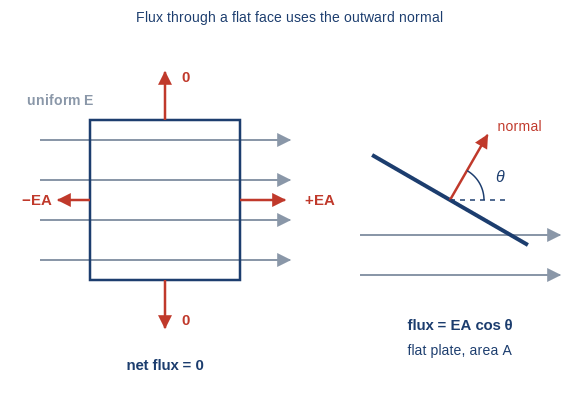
Picture electric field lines as arrows streaming through space. Flux counts how much field passes through a surface. For a flat piece of surface of area AA in a uniform field of strength EE, the flux is

Φ=EAcos⁡θ\Phi = EA\cos\theta

Here Φ\Phi (capital phi) is the flux, EE is the field strength in N/C, AA is the area in m2\text{m}^2, and θ\theta is the angle between the field and the normal, the line sticking straight out of the face. The unit of flux is N⋅m2/C\text{N}\cdot\text{m}^2/\text{C}.

For a closed surface (a box, a ball, any shape with an inside and an outside), we always use the outward normal. Field leaving the surface gives positive flux. Field entering gives negative flux. The net flux is the sum over every piece of the surface.

A closed box in a uniform field with outward normals on each face, and a tilted flat plate whose normal makes angle theta with the field

Problem 2

  • Core
  • True or false
  • No calculator
  • 3 pts

A point charge of +2.0+2.0 nC sits at the center of a spherical Gaussian surface of radius 0.100.10 m. A student claims that replacing the surface with a concentric sphere of radius 0.200.20 m cuts the net electric flux through it to one quarter of its first value, because the field at the surface falls off as 1/r21/r^2.

Is the statement true or false?

Problem 3

  • Core
  • Multiple choice
  • No calculator
  • 3 pts

A point charge sits exactly at the center of a cube. The net flux through the whole cube is q/ε0=600 N⋅m2/Cq/\varepsilon_0 = 600\ \text{N}\cdot\text{m}^2/\text{C}. What is the electric flux through one face of the cube?

Choose one answer

Open the rest of this lesson, free

The full lesson and all 13 of its problems, with every worked answer.

I am aI am a

Your free lesson opens right here, on this device for 30 days. We'll email you occasional TJ class prep updates. Unsubscribe anytime.

How it works

Class prep that works alongside class

A complete quantum and electrodynamics course for students who have finished AP Physics C. Work alongside your school course or study the material in sequence. Each lesson starts with a physical setup, develops one calculation, and shows a check before you try the practice.

  • Original problems in several formats: true or false, multiple choice, multi-part and free response.
  • Each one is marked core, test level or beyond.
  • Maxwell equations, electromagnetic waves, special relativity, the Schrodinger equation, bound states, measurement, photons, and qubits.
  • A worked answer for every problem, ending with the mistake that most often costs points.
  • Flux, the Lorentz factor, hydrogen levels, Compton scattering, and outcome probabilities.

What is inside

  1. 1Maxwell's Equations and Potentials6 lessons · 78 problems
  2. 2Electromagnetic Waves and Energy Flow6 lessons · 78 problems
  3. 3Special Relativity and Relativistic Electrodynamics6 lessons · 78 problems
  4. 4Foundations of Quantum Mechanics6 lessons · 78 problems
  5. 5Bound States6 lessons · 78 problems
  6. 6Measurement, Spin, and Entanglement6 lessons · 78 problems
  7. 7Photons and Matter6 lessons · 78 problems
  8. 8Quantum Information and an Introduction to QED6 lessons · 78 problems
The front entrance of Thomas Jefferson High School for Science and Technology
Neil Kothari, co-founder of EduAvenues

Who built it

Neil Kothari

TJHSST alumnus · Co-founder, EduAvenues · 10+ years in TJ preparation

Neil is a TJ alumnus and has spent more than a decade working with TJ students and their families. He built this course so students can set up a field, a wave, or a quantum state and finish the calculation. Every problem is written for the course and every answer is checked before it goes in.

Tuition

$395for the full school year

One tuition covers every unit of the course. All 8 units are open now. The Gauss's Law and Electric Flux lesson stays free for everyone.

  • All 8 units: 48 lessons and 624 original problems
  • A worked answer for every problem
  • Access through the end of the school year
Enroll
TJ Quantum and Electrodynamics | EduAvenues