Class prep · TJ Senior Research Lab

Frame the question,then defend the result.

A complete senior research lab course, from a workable question through literature, methods, evidence, the paper, and the talk. Every practice exercise has a model answer and a rubric. Built by Neil Kothari, a TJ alumnus.

$395 covers the full school year. The first lesson is free.

Try one. This is a checkpoint exercise from the course.

Problem 1

  • Core
  • Multiple choice
  • No calculator
  • 4 pts

Which planning sentence fits an in-house engineering lab whose director has posted a February lab-meeting talk and a June paper?

Choose one answer

practice exercises, each with a model answer
288
practice exercises, each with a model answer
at test level or beyond
144
at test level or beyond
short lessons, one for every topic
48
short lessons, one for every topic
units, all open now
8
units, all open now

Free lesson

Lesson 1.1: What the Year Asks You to Finish

Every senior research student finishes a paper and a public talk, and your path decides the extra duties and dates on top of that.

Start with what the year asks you to finish, and whose dates you follow.

Start with a question

Two friends sign up for the same 5K race. One runs it with a school team. The other runs it with a neighborhood club. Both have to cross the same finish line. But the team runner also has practice three days a week and a coach who sets the schedule, while the club runner meets on Saturdays and checks in with a different leader.

If the club runner copied the team's practice schedule, nobody would call that "being thorough." It would just be the wrong schedule.

The senior research year works the same way. Every student crosses the same finish line: a paper and a public presentation. But students reach that line on different paths, and each path adds its own duties and dates. The most common mistake in the first weeks is copying a rule from the wrong path.

By the end of this lesson you will be able to:

  • name the two products every senior research student finishes,
  • tell a shared product apart from a duty that belongs to one path only,
  • list the duties the Mentorship guides describe for that path,
  • turn a lab director's posted milestones into a year plan without adding dates nobody gave you,
  • answer a friend who stretches "consistent with" into "identical to."

The two paths and the one finish line

The senior research year means you either join a research lab at school, or, in some cases, join the separate Mentorship program. Here is what each word means in plain terms.

  • An in-house lab is a research lab at the school, run by a lab director (the teacher in charge of that lab).
  • Mentorship is a separate program. You work off campus with an external mentor, a researcher or professional outside the school.

Both paths finish with the same two products.

  1. A paper. It follows the form of your field. Readers expect the need (why the question matters), background (what is already known), a method someone else could follow, your findings, what the findings mean, the limitations (what your study cannot show), and a bibliography (your list of sources).
  2. A public presentation. Every senior research student presents at tjSTAR, the Thomas Jefferson Symposium to Advance Research. At tjSTAR you present your own work, see other labs' work, and look ahead to research after TJ.

The 2024-25 student handbook describes the Mentorship paper this way: it covers the setting, the need, the methodology, the analysis, the data, graphical displays, a discussion, a conclusion and a bibliography. Those are the same jobs a lab paper does, just listed in more detail.
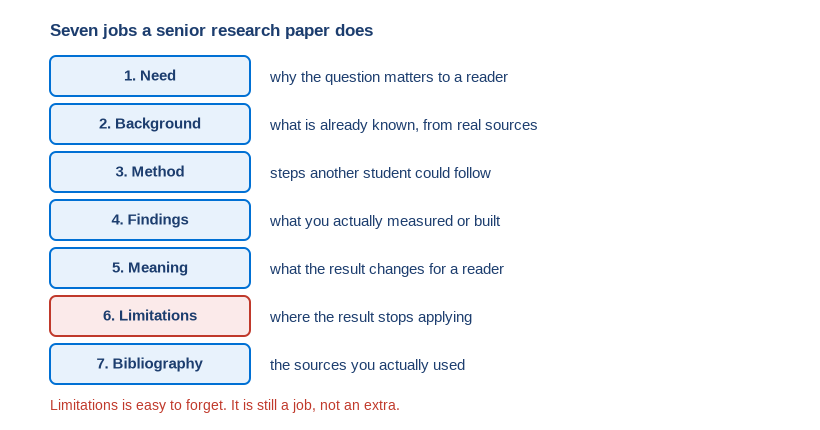
The jobs a senior research paper does, in order: need, background, method, findings, meaning, limitations, bibliography

Who sets the dates. In an in-house lab, the lab director sets the length of your talk slot, the date your work must be ready, and the draft deadlines. This course does not replace that calendar, and it does not publish a substitute. If you do not know a date yet, the right entry in your plan is "ask the director," not a guess.

The director also decides points, late penalties and safety rules for the lab. The FCPS grading policy still applies on top of that. You never invent your own penalty or your own deadline.

Problem 2

  • Core
  • True or false
  • No calculator
  • 2 pts

True or False: Every TJ senior research student must submit a Mentorship Showcase abstract three weeks before an April showcase. Justify with the rule from the lesson.

Is the statement true or false?

Open the rest of this lesson, free

The full lesson and all 6 of its exercises, with every model answer.

I am aI am a

Your free lesson opens right here, on this device for 30 days. We'll email you occasional TJ class prep updates. Unsubscribe anytime.

How it works

Class prep that works alongside class

A complete senior research lab course for students heading into a senior research year. Work alongside the lab. Each lesson shows a worked example, then a practice exercise with a model answer and a rubric.

  • Practice exercises in several formats: true or false, multiple choice, multi-part and free response.
  • Each one is marked core, test level or beyond.
  • Questions, literature, methods, evidence, writing and presentation.
  • A model answer and a rubric for every exercise.
  • Worked examples of a weak draft and a stronger revision.

What is inside

  1. 1The Senior Research Year6 lessons · 36 exercises
  2. 2Questions and Design Goals6 lessons · 36 exercises
  3. 3Reading the Literature6 lessons · 36 exercises
  4. 4Methods You Can Repeat6 lessons · 36 exercises
  5. 5Evidence, Statistics, and Figures6 lessons · 36 exercises
  6. 6Writing the Paper6 lessons · 36 exercises
  7. 7Talks, Posters, and tjSTAR6 lessons · 36 exercises
  8. 8The Year in Practice6 lessons · 36 exercises
The front entrance of Thomas Jefferson High School for Science and Technology
Neil Kothari, co-founder of EduAvenues

Who built it

Neil Kothari

TJHSST alumnus · Co-founder, EduAvenues · 10+ years in TJ preparation

Neil is a TJ alumnus and has spent more than a decade working with TJ students and their families. He built this course so a student can frame a question, keep a method someone else could follow, and explain a result without overclaiming.

Tuition

$395for the full school year

One tuition covers every unit of the course. All 8 units are open now. The What the Year Asks You to Finish lesson stays free for everyone.

  • All 8 units: 48 lessons and 288 practice exercises
  • A model answer and a rubric for every exercise
  • Access through the end of the school year
Enroll