According to the Association of American Medical Colleges (AAMC), in 2025, 54,699 people applied for 23,440 seats, a 5.3% applicant increase after three straight years of decline. A high GPA and MCAT score are no longer enough to differentiate competitive applicants.
Taking a look at AAMC’s MCAT and GPA Grid for Applicants and Acceptees to U.S. Medical Schools, applicants with a 3.80-plus GPA and a 518-plus MCAT are accepted at a rate of roughly 83%. About one in six people with elite stats still do not get into medical school.
My team and I have worked on more than 25,000 medical school applications. When we look at what separates students who get in from students with nearly identical stats who do not, clinical experience becomes the main differentiator. Many applicants assume more is automatically better. The focus should be the quality of the experience.
Why applicants fixate on hours, and why that is the wrong metric
Hours are the part of the Work & Activities section where you have to add numbers, so many applicants treat them like a scoring metric. Students immediately start comparing themselves against strangers online.
Three misconceptions drive most of the anxiety I see.
The first is that a published clinical-hour threshold exists somewhere online. The AAMC does not set a required number of clinical hours, and very few medical schools I have helped students get into publish one either.
Second, averages are targets. Admissions experts across our team agree that around 500 hours of clinical experience is a strong target for medical school. A single year in a full-time clinical role can add 2,000 hours to an applicant’s clinical or shadowing experience.
The third is the assumption that more is always better. Accumulating 400 to 800 hours in the same role doing the same task usually does not affect an application as much as you think.
What actually distinguishes strong clinical experience
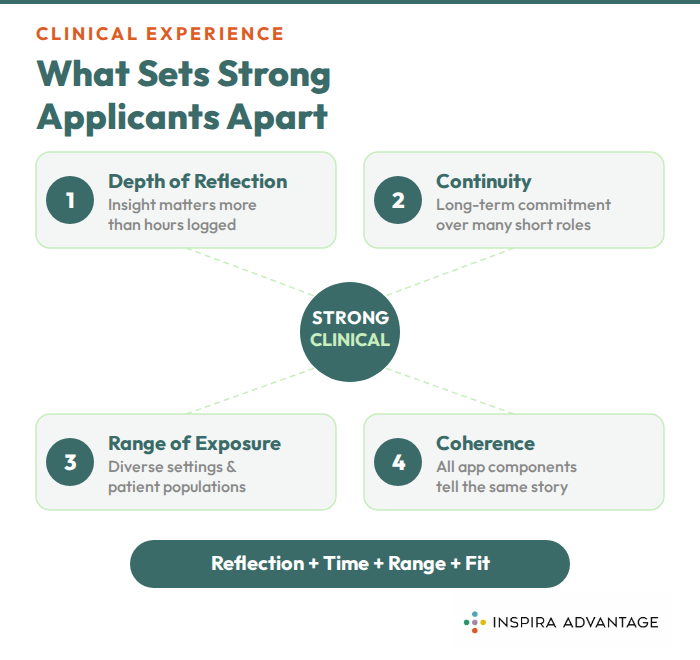
Depth of reflection
Imagine two students who each spend 150 hours in an emergency department. One describes the experience as gaining exposure to emergency medicine and supporting the clinical team. The other explains how they witnessed a patient refuse a surgical procedure, until the physician explained why that procedure was necessary for the patient’s survival.
Both experiences produced the same number of hours. Only one applicant has shown the reader that they understand what a physician does.
That is why I tell my students that online shadowing counts as good clinical experience if they reflect on it well enough.
The AAMC’s 17 premed competencies explain what a student needs to demonstrate on an application. A student who watches recorded clinic sessions can still be in a better position than a student who sat in an operating room for 60 hours and can only write, “I really liked seeing different surgeries.”
While clinical experience is an important part of a medical school application, ultimately, the number of hours is not the point. Ideally, students use these experiences to walk a mile in a doctor’s shoes. They should come away with a better understanding of what caring for patients actually involves, including the parts of the job that are difficult, uncertain, or less visible, and whether this is a career they truly want.
Clinical experience can be a way to provide service to patients and the healthcare team. In return, students gain exposure to the realities of patient care, including competing priorities, teamwork, trust, and caring for people during vulnerable moments. No experience can fully prepare someone to become a physician, but meaningful, sustained involvement can help students test their assumptions about the profession. When I served as a medical student member of an admissions committee, applicants with substantive clinical experiences were usually better able to explain why they wanted to become physicians and what their future careers might look like. What stood out was not the number of hours they had completed, but their engagement and how thoughtfully they reflected on the experience. Medicine is a long career, and clinical experience should help students understand what they are signing up for and why they want to do it.
Dr. Aanika Warner, a physician and Director of Medical School Admissions Advising at Inspira Advantage.
Continuity over box-checking
The pattern our admissions experts see all the time is an applicant with six activities, each around 60 hours, all started within a few months of applying. They have around 360 hours of clinical experience, but the short time in each role suggests they were never fully committed to any single one.
What makes a clinical experience strong is its longitudinal component. Reviewers would rather see two hours every other week in one role for two years than 30 hours over the last two weeks in another.
If you spend at least one year in a single role, you are more likely to acquire responsibility, and your supervisor can write about specific actions that showed growth. Admissions committees want a trajectory. A trajectory takes time in one role.
Range of exposure
Strong clinical experience shows that you have worked in different settings with different kinds of patients. An applicant whose entire clinical exposure is one academic medical center cannot show the range reviewers are looking for.
The strongest files usually show some contrast: outpatient and inpatient, insured and uninsured, acute and chronic. Hospice volunteering, a community clinic, and an emergency department tell a reader more than 400 hours in one suburban practice.
Coherence across the application
Your personal statement, activity descriptions, letters, and secondaries are read together, often by the same person.
When a student writes about rural access but their clinical experience was only in a university hospital, the reader notices. When a personal statement turns on a hospice moment and the hospice entry shows 20 hours, that creates a disconnect. The strongest applicants answer the same question in every part of the file, from different angles.
Substance over volume
You do not need a specific number of clinical hours to get into medical school. A student with 150 clinical hours who can say exactly what they learned, and how that will make them a better physician, is in a much better position than an applicant with 800 hours and no story.
The question worth asking is not whether you have enough hours. It is whether someone reading your application would believe you have seen the work clearly and still want it.
About Arush Chandna
Arush Chandna is the Co-Founder of Inspira Advantage and a Dartmouth College graduate with more than 12 years of experience in graduate healthcare admissions. He works alongside physicians and former medical school admissions officers who advise applicants to U.S. medical programs.